IdeaBlocksExpressing and Reusing Divergent Intents for Graphic Design Exploration using Generative AI





TL;DR
Hover each card to jump to the relevant section
Divergent intent can be decomposed into Property, Direction, and Range
See how the divergent intent is decomposed into three dimensions: Property, Direction & Range
Explore the framework →IdeaBlocks modularizes divergent intents into reusable Exploration Blocks — shareable across Block, Path, and Project levels.
Create Exploration Blocks, chain properties, and see block reuse in action
Try IdeaBlocks demo →Users generated 2.13× more images with 12.5% greater diversity; a 3-day study revealed diverse intent reuse strategies.
See how IdeaBlocks supports divergent exploration and reuse, through two studies.
View results →Motivation
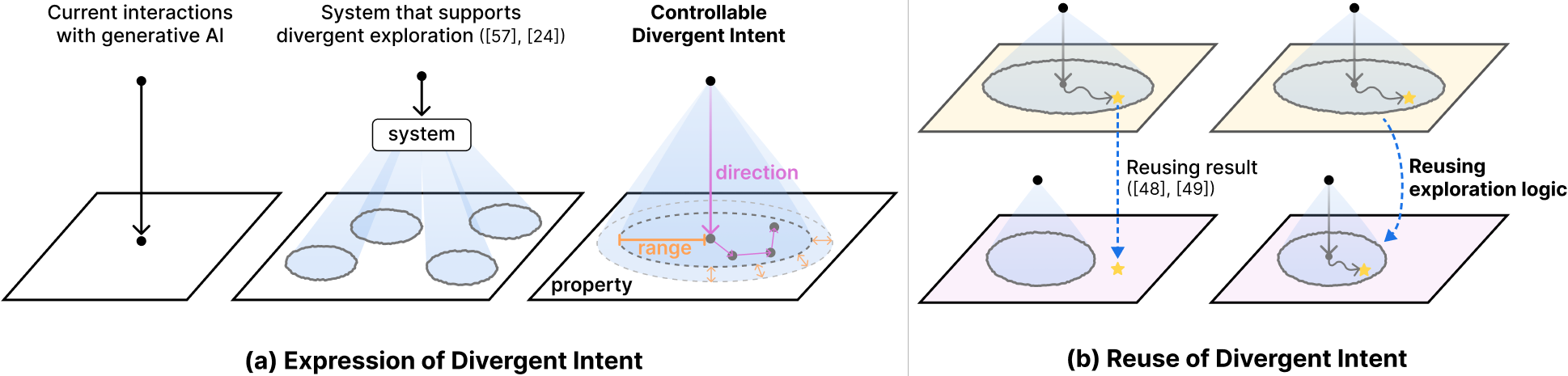
Current Generative AI is optimized for convergence — not exploration.
No control over exploration boundaries
Current GenAI interactions encourage users to specify a fixed target through prompt refinement, leaving no mechanism to define the scope or direction of exploration parametrically.
Exploration strategies can't be transferred
Text prompts entangle content (what to draw) with exploration logic (how to vary), making it impossible to decouple and reuse a successful search strategy in a new context.
Divergent Intent Framework
We define Divergent Intent as a parameterizable construct.
Through formative study analysis, we identified three components that together define the space a designer intends to explore.
Click a region to see details.
Property
"What to explore"
The specific design dimension to focus on — the axis along which exploration moves.
"I like the character, just change the background style." — P7
Interaction Design Space
Divergent intent reuse operates across two dimensions.
What granularity is reused, and how flexibly it adapts to new contexts.
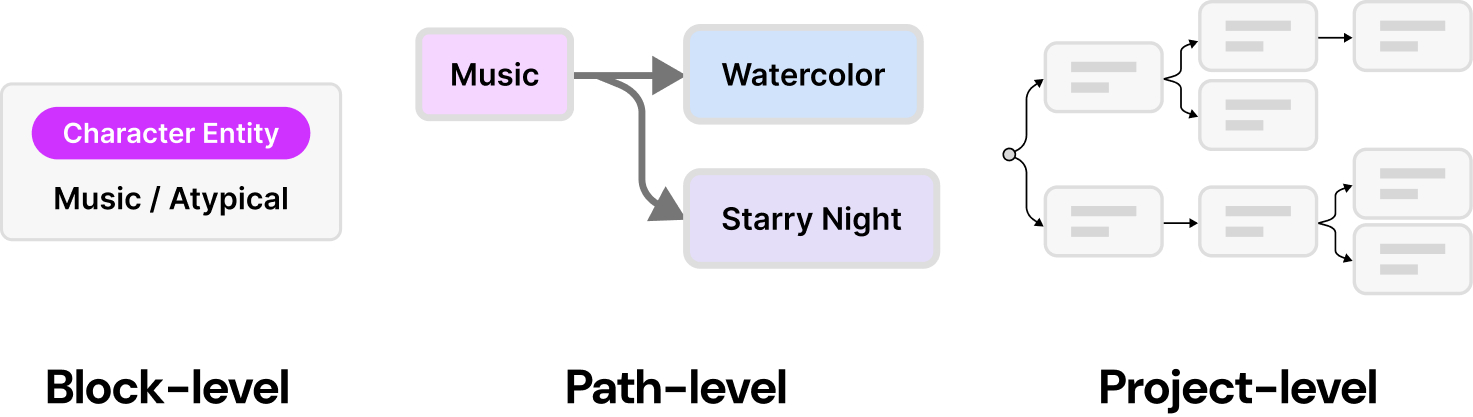
Units
What granularity of exploration strategy should be reusable?
Block-level — A single property intent
Path-level — A multi-step exploration strategy
Project-level — An entire design space template
Adaptivity
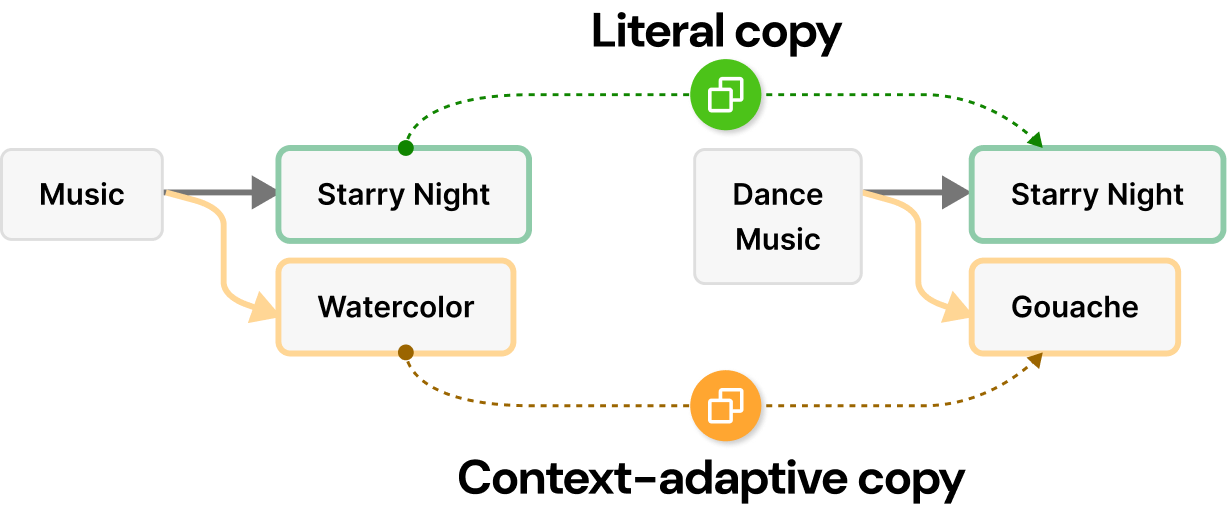
How fixed or flexible should that reuse be?
Literal copy — Exact intent applied verbatim
Context-adaptive copy — Intent reinterpreted for the new context
The System
IdeaBlocks lets designers modularize divergent intents into Exploration Blocks — and reuse them.
Try out demo of three core features of IdeaBlocks (operating with pre-generated examples).
IdeaBlocks lets you create Exploration Blocks by specifying Property, Direction, and Range — and generate suggestions as text or images. In the demo below, pick a property card, set a direction and typicality, and browse the suggestions!
System Walkthrough
For the full workflow of using IdeaBlocks, check out this video figure.
Comparative Study
IdeaBlocks significantly enhances divergent exploration.
Within-subjects comparative study · N=12
Hover each stat to see more detail
Longitudinal Study
How designers appropriate reuse features in practice.
Three-day deployment study · N=6
Hover cards to reveal participant quotes
Visual Assets as Personal Palettes
Designers consistently reused visual properties (image styles, color palettes) as cross-project palettes reflecting personal taste. Semantic properties (entities, poses) were more context-dependent and often adapted.
"Just like storing color swatches, I treated styles and colors as palettes to apply across projects."— D4
Template-like Scaffolding
Exploration paths (e.g., entity → style → pose) became recognized as recurring personal strategies. Path reuse grew steadily over three days: from 2.10 uses on Day 1 to 3.30 on Day 3.
"If we can make templates of the exploration order, it would allow quick, adaptive ideation for many topics with just one click."— D2
Social Reuse as Collective Exploration
Project reuse served two purposes: bootstrapping (avoiding a blank start) and broadening options (finding inspiration when stuck). Others' explored projects were trusted more than algorithmic suggestions.
"Others' projects felt more valuable because those people must have actually found good things."— D4
Design Implications
Design Implications for Future Intent-Reuse Systems
Differentiate reuse mechanisms by property type and expertise.
Visual properties and properties where users have strong familiarity benefit from literal reuse as cross-project palettes. Semantic properties benefit from adaptive reuse for contextual flexibility.
Help users recognize and formalize their exploration strategies as path templates.
Path-level patterns should be surfaceable so designers can save and reapply their own recurring strategies across topics.
Treat bootstrapping and broadening as distinct purposes in social reuse.
For bootstrapping, surface the overall flow of intent evolution. For broadening, foreground intermediate steps and strategies rather than full processes or final outputs.
Offer adaptive variants alongside literal reuse, and introduce nudges to prevent fixation.
Recency fading (de-emphasizing recently reused blocks) can discourage over-reliance and encourage discovery of less familiar strategies.
Citation
@inproceedings{10.1145/3800645.3813005,
  author = {Choi, DaEun and Son, Kihoon and Yu, Jaesang and Jung, HyunJoon and Kim, Juho},
  title = {IdeaBlocks: Expressing and Reusing Divergent Intents for Graphic Design Exploration using Generative AI},
  year = {2026},
  isbn = {9798400725630},
  publisher = {Association for Computing Machinery},
  address = {New York, NY, USA},
  url = {https://doi.org/10.1145/3800645.3813005},
  doi = {10.1145/3800645.3813005},
  abstract = {While designers increasingly leverage Generative AI for divergent exploration, current interaction is optimized for convergent refinement, forcing users to specify fixed targets rather than open-ended search spaces. Based on a formative study (N=7), we define the anatomy of Divergent Intent, comprising property, direction, and range, and identified two critical barriers: the lack of mechanisms to explicitly shape the parametric boundaries of exploration and the difficulty of reusing successful search strategies. We present IdeaBlocks, where users can modularize divergent intents into Exploration Blocks. Users can reuse prior intents at multiple levels (block, path, and project) with options for literal or context-adaptive reuse. In our comparative study (N=12), participants using IdeaBlocks explored 2.13 times more images with 12.5\% greater visual diversity than the baseline, demonstrating how structured intent expression and reuse support divergent exploration. A three-day longitudinal study (N=6) further revealed how different reuse mechanisms allowed distinct creative strategies, offering design implications for future intent-aware design support tools.},
  booktitle = {Proceedings of the 2026 Designing Interactive Systems Conference},
  pages = {621–642},
  numpages = {22},
  keywords = {Creativity support tool, Design exploration, Generative AI, Graphic design, Divergent intent},
  location = {Singapore, Singapore},
  series = {DIS '26}
}